


![A3e6aeb2 365f 4942 8458 c79264a5a965[1]](https://fischerinvestmentstrategies.com/wp-content/uploads/a3e6aeb2-365f-4942-8458-c79264a5a9651.png)
Private investment opportunities can offer access to companies and investments that are not available through the public stock market. However, many of these opportunities are limited to individuals who meet specific requirements established by the U.S. Securities and Exchange Commission (SEC).
One term investors often encounter when exploring private markets is accredited investor. But what does accredited investor actually mean, and how do you know whether you qualify?
Understanding the SEC’s accredited investor requirements can help you determine whether certain private investment opportunities may be available to you and what to consider before participating.
What Is an Accredited Investor?
An accredited investor is an individual or entity that meets certain financial, professional, or other requirements established under U.S. securities laws.
The SEC uses accredited investor standards in connection with certain private securities offerings. These standards are intended to identify investors who are considered capable of evaluating and bearing the risks associated with investments that may have fewer disclosure requirements than publicly registered securities.
Being an accredited investor does not mean that an investment is safe, guaranteed, or appropriate for your financial situation. It simply means that you meet the applicable criteria to participate in certain offerings.
Why Does Accredited Investor Status Matter?
Many private investment opportunities are not registered with the SEC in the same way publicly traded securities are. Certain exemptions from registration allow companies and investment sponsors to raise capital from investors who meet specific requirements.
As a result, accredited investor status can provide access to investment opportunities that may not be available to the general public.
- These may include certain:
- Private company investments
- Private placements
- Venture capital investments
- Private equity investments
- Pre-IPO investment opportunities
For investors interested in private markets, understanding the requirements is an important first step.
How Do You Qualify as an Accredited Investor?
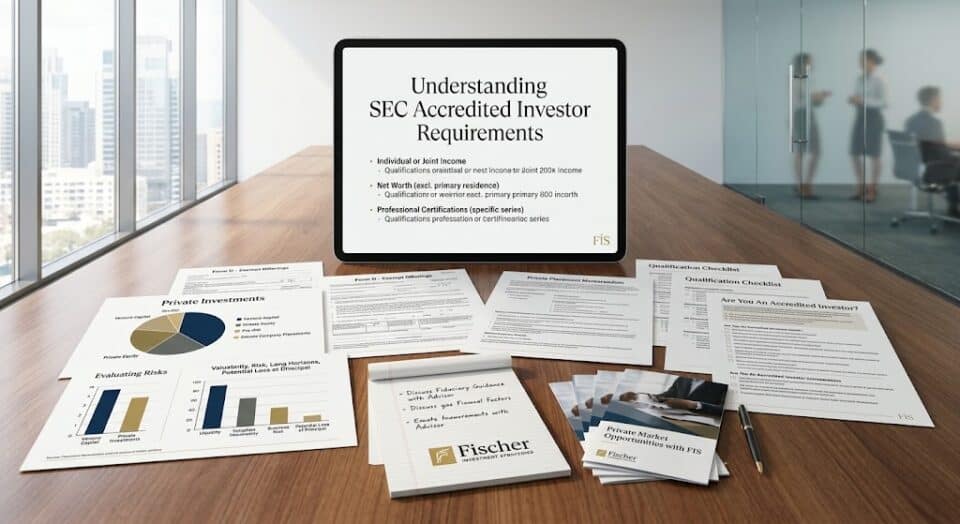
The SEC provides several ways an individual may qualify as an accredited investor. For individuals, qualification can generally be based on income, net worth, or certain professional credentials and designations.
The specific requirements can be detailed, and investors should review the current SEC rules when determining whether they qualify.
Income Requirements
One common path to accredited investor status is based on income.
Under the SEC’s current rules, an individual generally qualifies based on income if they:
Had individual income exceeding $200,000 in each of the two most recent years, or joint income with a spouse or spousal equivalent exceeding $300,000 in each of those years; and
Have a reasonable expectation of reaching the same income level during the current year.
The income test generally looks at the individual’s or couple’s income history as well as their expected income for the current year.
Net Worth Requirements
An individual may also qualify based on net worth.
Generally, an individual or an individual together with a spouse or spousal equivalent must have a net worth exceeding $1 million, excluding the value of their primary residence.
There are additional rules concerning liabilities and certain situations involving a primary residence, so determining net worth for accredited investor purposes is not necessarily as simple as adding up all of your assets.
Professional Certifications and Designations
The SEC also recognizes certain professional certifications, designations, and credentials as a potential basis for accredited investor status.
The SEC has established a process for recognizing qualifying credentials, and investors should check the current requirements rather than assuming that any financial or professional designation automatically qualifies them.
Can You Qualify in More Than One Way?
Yes. An investor may meet the accredited investor definition through more than one qualification pathway.
For example, an individual could meet the income requirements as well as the net worth requirements.
The important point is that accredited investor status is based on meeting the applicable regulatory criteria. Simply having significant investment experience or being financially knowledgeable does not necessarily make someone an accredited investor.
What Does Accredited Investor Status Allow You to Do?
Accredited investor status can make an investor eligible to participate in certain private investment opportunities that may otherwise be unavailable to them.
For example, some investors explore private company investments before a company becomes publicly traded. These types of pre-IPO investment opportunities may be available only to investors who meet applicable eligibility requirements.
However, qualifying as an accredited investor does not mean that every private investment is appropriate or that an investor should participate in every opportunity for which they qualify.
Eligibility and suitability are two different questions.
What Are the Risks of Private Investments?
Private investments can have characteristics that differ significantly from publicly traded investments.
Before participating, investors should understand potential risks such as:
- Limited liquidity: Private investments may not be easy to sell, and investors may need to hold them for an extended period.
- Valuation uncertainty: Private companies may not have a publicly established market price.
- Limited information: Private companies may provide less financial information than publicly traded companies.
- Business risk: A private company’s growth plans may not develop as expected.
- Potential loss of principal: Investors can lose some or all of the money invested.
- Long investment horizons: A future IPO, acquisition, or other liquidity event may take longer than expected—or may not happen at all.
These considerations are particularly important when evaluating investments in companies that are still privately held.

Accredited Investor Status Does Not Mean an Investment Is Right for You
Meeting the SEC’s requirements is only one part of the decision-making process.
An investor may qualify as an accredited investor but still decide that a particular private investment does not fit their financial situation.
Before considering an opportunity, it can be helpful to evaluate:
- Your overall financial goals
- Your investment time horizon
- Your need for liquidity
- Your tolerance for investment risk
- Your existing portfolio
- Your level of diversification
- The amount you are comfortable committing to less-liquid investments
For example, an investor who expects to need a significant portion of their assets within the next few years may have different considerations from someone with a longer investment horizon.
Why Fiduciary Guidance Can Be Valuable
Private investment opportunities can be complex, particularly when information is limited and investment timelines are uncertain.
A fee-only fiduciary advisor can help investors look at an opportunity in the context of their broader financial plan rather than evaluating it in isolation.
At Fischer Investment Strategies, our team takes a long-term approach to investment planning. We believe investment decisions should be considered alongside an investor’s broader goals, risk tolerance, liquidity needs, and financial circumstances.
Accredited investor status may open the door to certain opportunities, but thoughtful planning can help determine whether walking through that door makes sense for you.
How to Determine If You May Qualify as an Accredited Investor
The SEC’s accredited investor definition includes several qualification pathways, and the rules can change over time. Investors should review the current SEC requirements and consider obtaining professional guidance when determining whether they qualify.
If you believe you may meet the requirements and are interested in exploring private market investments, it is also important to evaluate whether those investments fit within your overall financial strategy.
If you would like to discuss your investment goals and whether private investment opportunities may fit into your broader plan, schedule a complimentary consultation with Fischer Investment Strategies. Our fee-only fiduciary team can help you evaluate investment decisions with your long-term financial goals in mind.
![Cee8f145 916e 4278 8da7 0b25fb7b81fc[1]](https://fischerinvestmentstrategies.com/wp-content/uploads/cee8f145-916e-4278-8da7-0b25fb7b81fc1.jpg)